At some point in the lifecycle of nearly every nonprofit website, someone — usually an executive director, occasionally a board member, sometimes a communications manager who has just discovered that the staff page still features three people who left during the previous administration — types a variation of the following into a search engine: website care plan.
The results, one imagines, are not entirely illuminating.
The term is industry jargon, deployed with cheerful confidence by web professionals and received with polite bewilderment by the nonprofit staff members at whom it is directed. It sounds, depending on one's frame of reference, like something a dentist would recommend, something an insurance salesperson would sell, or something that involves considerably more paperwork than anyone has time for.
It is, in practice, none of these things. It is something considerably more useful.
What Is a Website Care Plan?
A website care plan is a monthly maintenance arrangement — typically with an outside provider — that ensures a WordPress website receives regular, consistent technical and content upkeep rather than intermittent emergency attention.
Think of it less as a product and more as a relationship. You are not buying a thing. You are engaging someone to show up, every month, and do the work that keeps your website functioning, secure, and accurately representing your organization — the work that, in the absence of such an arrangement, reliably does not get done.
A website care plan is the formalized version of monthly website maintenance. The maintenance is the activity; the care plan is the commitment that ensures the activity actually occurs, on schedule, with defined accountability.
What Does a Website Care Plan Include?
A website care plan typically includes WordPress core and plugin updates, regular backups, security monitoring, uptime alerts, and a monthly allocation of hours for content updates and fixes. The specifics vary by provider and by plan tier, but a responsible care plan addresses all three layers of a healthy website.
The technical layer — the part that runs invisibly in the background and that most people only think about when it fails:
- WordPress core updates applied carefully, with backups taken first and post-update testing to confirm nothing broke in the process
- Plugin and theme updates, managed with attention to compatibility rather than applied indiscriminately
- Daily backups stored off-server, tested periodically to confirm they can actually be restored
- Security scanning and malware monitoring
- Uptime monitoring with alerts when the site goes down — so you find out before your donors do
- SSL certificate management and renewal
- Performance monitoring and basic speed optimization
The content layer — the part that makes the site an accurate representation of the organization rather than a time capsule:
- A monthly allocation of hours for content updates: staff changes, program descriptions, event listings, news items
- Broken link detection and repair
- Image optimization for new uploads
- Basic formatting and layout consistency as new content is added
The design layer — the part that most maintenance services skip entirely, and that separates a care plan from a mere technical subscription:
- Review of the site's visual coherence as content accumulates
- Attention to the small inconsistencies that erode professionalism over time: the stretched photograph, the mismatched heading style, the new page built without the correct template
- Proactive notice when something looks off, rather than waiting to be asked
It is this last layer that distinguishes a thoughtful website care plan from an automated service. Anyone can schedule plugin updates. The value of a genuine care relationship is in the human attention — someone who looks at the site with the same critical eye your donors bring to it, and who catches the things that undermine trust before they have a chance to do so.

Why Do Nonprofits Need a Website Care Plan?
Nonprofits need a website care plan because they are disproportionately unlikely to maintain their websites consistently without one. The combination of high staff turnover, absent dedicated web roles, constrained budgets, and mission-first priorities creates a structural maintenance deficit that good intentions reliably fail to close.
This is not a criticism. It is an observation about organizational reality that the nonprofit sector has largely normalized without examining too carefully.
Consider what happens in the absence of a care plan. The website is, nominally, someone's responsibility. That someone also runs the newsletter, manages volunteer coordination, handles communications with three different program funders, and is currently preparing for the annual gala. The website gets attention when it is visibly broken and minimal attention otherwise.
WordPress, meanwhile, releases security updates on its own schedule. Plugins update themselves, or don't, depending on settings that whoever configured the site may or may not have adjusted before leaving. Vulnerabilities accumulate. Content drifts. The staff page acquires, in the manner of certain family photo albums, a documentary quality that was not entirely intended.
A website care plan does not require the organization to solve any of this. It requires only that someone outside the organization — someone for whom the website is a primary responsibility rather than a supplementary one — is accountable for keeping it in order.
That is, in essence, what you are purchasing: accountability. And in the particular context of nonprofit website maintenance, accountability is the scarce resource.
What Is the Difference Between a Website Care Plan and a Website Redesign?
A website care plan maintains and improves an existing site over time; a website redesign builds a new one. These are different solutions to different problems, and conflating them is one of the more expensive mistakes a nonprofit can make.
A redesign is appropriate when a site's architecture is genuinely obsolete, when the organization's brand has changed substantially, or when the site's underlying technology is no longer supportable. A redesign costs, depending on the provider and the complexity of the project, between $5,000 and $50,000. It takes months. It is disruptive. It produces a new site that will, without a care plan following it, arrive at approximately the same condition as the current site in two to three years.
A website care plan is appropriate when the existing site is fundamentally sound but has been inadequately maintained. It costs between $99 and $400 per month. It is continuous rather than disruptive. And it produces, over time, a site that improves incrementally rather than one that is rebuilt dramatically and then neglected again.
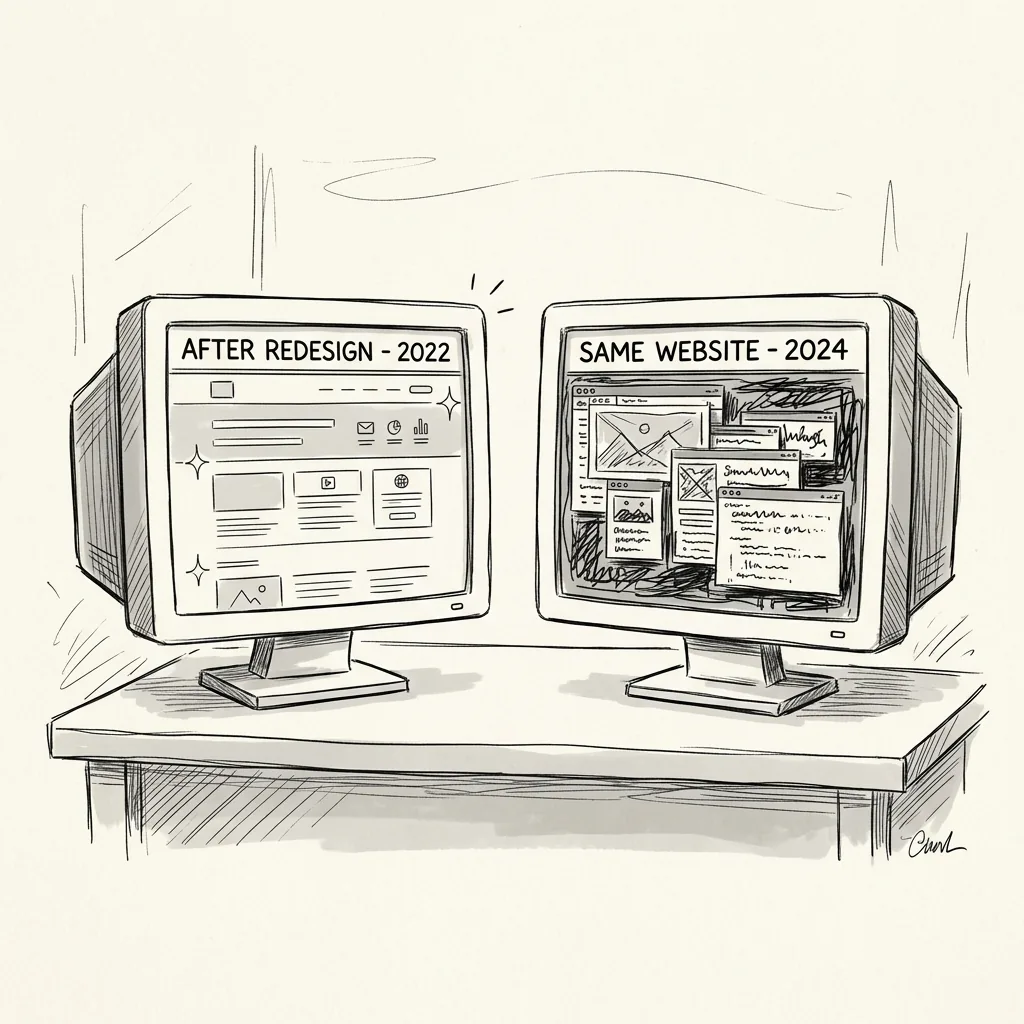
Many organizations that believe they need a redesign actually need a care plan. The redesign impulse is understandable — there is something appealing about the idea of starting fresh, of having a site that is visibly, unambiguously new — but it frequently mistakes the symptom (the site looks bad) for the cause (the site has been neglected). A new site, neglected in the same way, will look just as bad within a few years.
The more honest question is not "do we need a new website" but "do we have a plan for maintaining whatever website we have." The answer to the second question shapes the value of any answer to the first.
How Much Does a Website Care Plan Cost?
A website care plan for a nonprofit typically costs between $199 and $400 per month for comprehensive coverage, with basic plans available from $99 per month. WordPress care plan pricing varies based on what's included, the size and complexity of the site, and whether hosting is part of the arrangement.
The market divides roughly as follows:
Entry-level plans ($99–$199/month) handle the technical essentials: updates, backups, security monitoring, uptime alerts. They may include a small monthly allocation of content hours — enough for minor updates but not for significant content management. Appropriate for organizations with simple, relatively static sites.
Mid-range plans ($200–$400/month) add meaningful content update hours, priority response times, performance monitoring, and usually hosting. This is the range most appropriate for active nonprofits — organizations with regular program updates, staff changes, event listings, and the kind of ongoing content management that requires a real, responsive relationship.
Custom and retainer arrangements ($400+/month) provide development capacity alongside maintenance — useful for organizations with complex integrations, accessibility remediation requirements, or websites that function as operational platforms rather than primarily as communications tools.
A few observations on wordpress care plan pricing that tend to be useful:
The cheapest plan is not always the most economical. A $99/month plan that doesn't include content hours will either leave content management undone — which defeats a significant part of the purpose — or result in hourly charges for work that falls outside the plan, which can add up quickly.
The question to ask is not "what is the monthly cost" but "what is included, what is excluded, and what happens when something urgent needs attention outside business hours." The answers to the second and third questions reveal more about the value of a care plan than the monthly price does.
How Is a Website Care Plan Different from Outsourcing Website Maintenance?
A website care plan is one form of outsourcing website maintenance — specifically, the form that involves a defined monthly arrangement with transparent scope and pricing. To outsource website maintenance more broadly might mean anything from a care plan to an ad hoc hourly arrangement to a retainer with a general web developer.
The advantage of a care plan over unstructured outsourcing is predictability — in cost, in scope, and in accountability. When you outsource website maintenance on an hourly or as-needed basis, the work happens when you remember to ask for it, which is to say intermittently, which is to say insufficiently. A care plan replaces the need to initiate with a commitment that is self-executing: the work happens because it is scheduled and expected, not because someone remembered to email.
For nonprofit organizations in particular — where staff bandwidth is limited and website maintenance sits perpetually at the bottom of the priority list — the self-executing quality of a care plan is not a minor feature. It is the point.
Do You Need a Website Care Plan? A Simple Test
The following questions require honest answers.
When were your WordPress plugins last updated? If the answer is "I'm not sure" or "sometime last year," the updates are overdue and the security risk is real.
Does anyone test your donation form regularly? Not look at it — actually submit a test transaction and confirm the downstream process works. If not, you do not currently know whether it is working.
Is the information on your staff page accurate? Are the people listed currently employed by the organization? Are their titles correct?
If your website went down tonight, how would you find out? Would you find out before your donors did?
Is there a specific person whose job it is to maintain the website — not as one item on a long list of responsibilities, but as a defined, calendared, primary responsibility?
If the answers to more than one or two of these questions are uncertain, a website care plan is not a luxury. It is the most direct solution to a problem that is already affecting your organization, even if the full extent of it isn't yet visible.
What Should You Look for in a Website Care Plan Provider?
The most important quality in a website care plan provider is not technical skill — it is accountability. You are looking for someone who will show up, every month, without being asked, and who will tell you when something needs attention rather than waiting for you to notice.
Beyond that, look for:
Nonprofit experience. Donation processing, accessibility requirements, the particular complexity of a website that serves clients, donors, volunteers, and board members simultaneously — these are not generic problems. A provider who has worked extensively with nonprofits will navigate both the technical and organizational context fluently.
Transparency about what's included. Every care plan should clearly define what is covered, what constitutes an additional charge, and what the response time commitment is for urgent issues. Ambiguity in these areas tends to resolve in the provider's favor.
A design sensibility. The best care plan providers do not limit their attention to the technical layer. They notice when the site's visual coherence is drifting and address it proactively — before the stretched photograph or the inconsistent layout becomes the impression a donor carries away.
References from nonprofit clients. Ask for them. Call them.
Vivienne offers website care plans built specifically for Connecticut nonprofits — monthly WordPress maintenance, security, backups, content updates, and the design attention that ensures your site continues to look like your organization. [See our care plans →]