There is a particular strain of optimism that runs through nonprofit organizational culture — a belief, genuinely held and frequently expressed, that the right combination of goodwill, shared purpose, and a sufficiently motivated volunteer can accomplish most things that paid professionals accomplish, at a fraction of the cost and with a great deal more heart.
It is an admirable instinct. It is also, as applied to WordPress website maintenance, almost always wrong.
This is not an argument for outsourcing everything, or for the proposition that professional services are always preferable to internal capacity. It is, rather, an attempt to examine the specific question of website maintenance honestly — including the case for keeping it in-house, which is a real case that deserves a fair hearing before being set aside.
What Does It Mean to Outsource Website Maintenance?
To outsource website maintenance means to engage an outside provider — typically through a monthly website care plan — to perform the ongoing technical and content upkeep that keeps a website secure, functional, and current.
It does not mean relinquishing control of the website. The organization retains ownership of its domain, its content, its hosting account, and every decision about what the site says and how it looks. Outsourcing maintenance means delegating the work of keeping that site healthy — not the judgment about what healthy looks like.
The distinction matters because the reluctance many nonprofits feel about outsourcing is often rooted in a conflation of the two. Handing over the plugin updates does not mean handing over the organization's voice.
What Is the Case for Managing Website Maintenance In-House?
The case for managing nonprofit website maintenance in-house is genuine, and it rests on three foundations: cost, control, and institutional knowledge.
Cost. An internal resource who maintains the website as part of a broader role costs the organization nothing incrementally, whereas a monthly website care plan costs between $199 and $400 per month. For organizations with genuinely constrained budgets and genuinely capable internal staff, the arithmetic is straightforward.
Control. An internal team member can make updates immediately, without the communication overhead of working through an outside provider. For organizations with high-frequency content changes — daily event updates, regular news items, continuous program changes — internal management can be more responsive.
Institutional knowledge. Someone who works inside the organization understands its voice, its programs, and its stakeholders in ways that take time to develop in an outside relationship. Content updates made by an internal staff member carry a contextual fluency that an outside provider may need months to develop.
These are real advantages. They are also, in the specific context of most small nonprofits, largely theoretical.
What Is the Case for Outsourcing Website Maintenance?
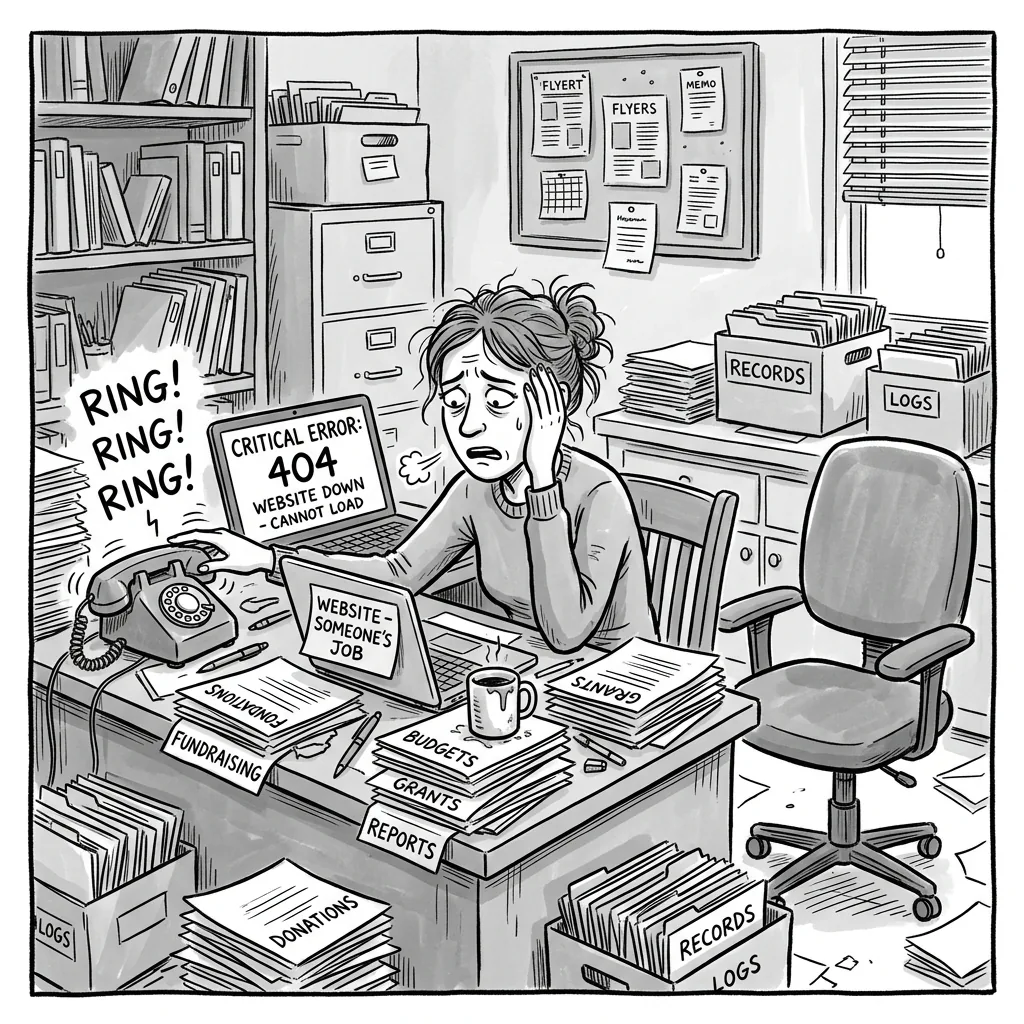
The case for outsourcing website maintenance rests on a single, decisive observation: the work that is everyone's responsibility in theory tends to be no one's responsibility in practice.
In a small nonprofit, the person nominally responsible for the website is also responsible for the newsletter, the social media accounts, the grant reports, the board communications, and whatever else arrived in their inbox this week. The website is the responsibility that has no deadline, no external accountability, and no immediate consequence when it is deprioritized.
Which means it is always deprioritized.
When you outsource website maintenance, you are not purchasing technical skill, exactly — although that is part of it. You are purchasing consistency. The guarantee that the work will be done on schedule, every month, regardless of what else is happening in the organization.
This is a more valuable thing than it sounds. Most nonprofit website problems — security vulnerabilities, broken forms, outdated content, declining search performance — do not result from a single catastrophic failure. They result from the steady accumulation of things that were not done when they should have been. A missed update here. A broken link left unfixed there. A staff page that nobody got around to updating after the last departure.
A monthly website care plan does not just perform maintenance tasks. It removes the organizational dependency on anyone's availability, attention, or continued employment. The work happens because it is someone's explicit, contractual responsibility — not because the right person happened to have a free afternoon.
The case for outsourcing is strongest when any of the following are true:
- No current staff member has both the technical knowledge and the available time to maintain the site consistently — not theoretically, but demonstrably, based on what has actually happened over the past twelve months.
- The website has experienced a security incident, a significant period without updates, a broken donation form, or any other evidence that current maintenance practices are insufficient.
- The executive director is currently the person who makes website updates, which means the organization's highest-cost staff member is performing its lowest-complexity web tasks.
- Staff turnover has left the organization without anyone who fully understands how the site is configured, where the credentials are, or what will happen if a major plugin update is applied without testing.
- The website is central to donor relationships, grant reporting, or client services — which is to say, the cost of something going wrong exceeds the cost of preventing it.
Who Should Be Responsible for Your Nonprofit Website?
The person responsible for your nonprofit website should be whoever has both the technical competence to maintain it and the dedicated, protected time to do so consistently — whether that is an internal staff member or an outside provider.
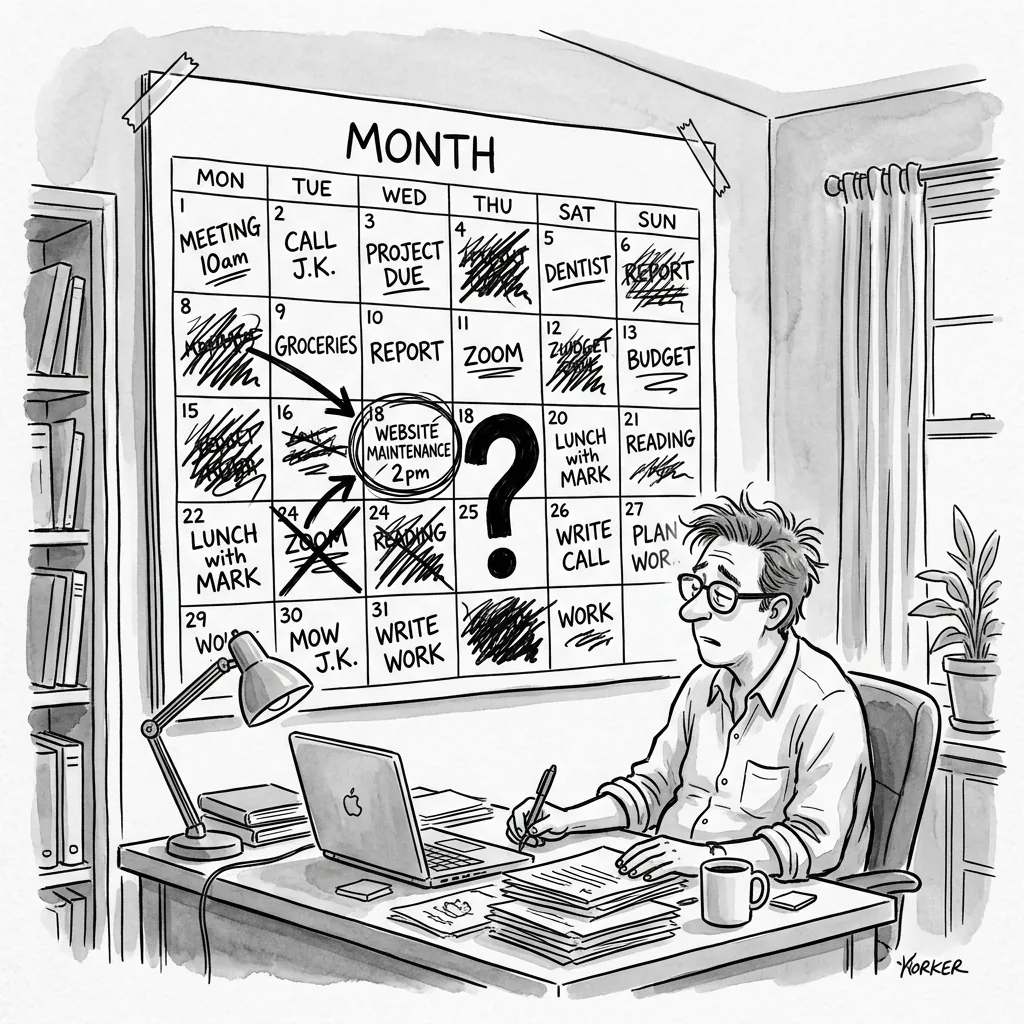
The key word is "dedicated." Not "can usually find time for it." Not "has WordPress experience from a previous role." Not "is very interested in learning." Dedicated time means the website maintenance tasks are on a calendar, have protected priority, and will be completed regardless of what else is competing for attention that week.
In most small nonprofits, that person does not exist internally. Not because the organization lacks capable staff, but because the organization's staffing model was not designed with website maintenance as a primary function.
The honest exercise is this: look at the past twelve months. Were WordPress core and plugins updated monthly? Was the donation form tested regularly? Were content updates made within a week of changes occurring in the organization? Was the site monitored for security issues?
If the answer to more than one of these is no, or uncertain, the current arrangement is not working — and the question is not whether to change it, but how.
What Should You Look for If You Decide to Outsource Website Maintenance?
If you decide to outsource website maintenance, look for a provider with documented nonprofit experience, transparent monthly pricing, clear response time commitments, and a design sensibility alongside technical competence.
Nonprofit experience specifically. The technical tasks involved in wordpress website maintenance are the same regardless of the client. The context is not. A provider who understands donation form compliance, accessibility obligations, the multiple stakeholder audiences a nonprofit site must serve, and the particular budget and communication sensitivities of the sector will be a better partner than one who is technically equivalent but organizationally unfamiliar.
Transparent pricing. Monthly website care plan pricing should be clearly defined, with explicit terms for what is included, what constitutes an additional charge, and what response time the organization can expect for urgent issues. A provider who is vague about any of these things is creating conditions for future conflict.
Real response time commitments. Ask specifically: if the donation form breaks on a Wednesday evening in November, what happens? The answer to this question reveals more about the practical value of a care plan than any list of included features.
A design eye, not just a technical one. The best maintenance relationships include someone who looks at the site with the same attention a thoughtful visitor would bring — noticing when visual consistency is eroding, when a new page doesn't quite match the rest of the site, when an image has been uploaded at the wrong dimensions. Technical maintenance keeps a site running. Design-aware maintenance keeps it representing the organization well.
References from nonprofit clients. Ask for them and contact them. Ask specifically: does the provider communicate proactively, or only when asked? Does the site look better or worse than when the relationship began? Would you renew?
What Should You Put in Place If You Keep Website Maintenance In-House?
If you decide to keep website maintenance in-house, you need three things: a named person, a documented protocol, and a protected schedule.
A named person means one specific individual — not "the communications team" or "whoever has time" — who is explicitly responsible for website maintenance. Their job description should reflect this. Their performance review should include it.
A documented protocol means a written maintenance checklist — covering weekly, monthly, quarterly, and annual tasks — that lives somewhere accessible and is not dependent on any one person's memory. This document should include login credentials stored securely, a record of all plugins and their purposes, hosting and domain renewal dates, and instructions for what to do when something breaks.
A protected schedule means maintenance tasks on a calendar that are treated with the same priority as grant deadlines and board meetings — not as the thing that gets moved when something more urgent arrives, which is always.
If all three of these are genuinely in place, in-house maintenance is viable. If any of them are aspirational rather than actual, the arrangement will produce the same results it has been producing.
The Honest Question
The decision about whether to outsource website maintenance ultimately comes down to a single honest question: not whether your organization is capable of maintaining its website internally, but whether it actually will.
Capability and execution are different things. Most nonprofits have staff members who could, with adequate time and attention, maintain the WordPress site competently. Most nonprofit websites are nevertheless inadequately maintained — not because of incompetence, but because the combination of competing priorities, limited time, and the absence of external accountability reliably produces the same outcome.
A monthly website care plan does not exist because nonprofits lack capable staff. It exists because capable staff have too many other things to do.
The website, in this reading, is not a technology problem. It is an organizational one. And outsourcing, at its best, is simply the practical acknowledgment that some organizational problems are most efficiently solved by someone outside the organization — someone for whom the website is not the seventh item on a long list, but the first.
Vivienne offers monthly website care plans for Connecticut nonprofits — transparent pricing, nonprofit-specific experience, and the design attention that most maintenance services don't include. [See what's included →]